The compliance control plane
for space operators.
AVOCET puts licensing artifacts, evidence, dependencies, and post-flight workflows in one place. You control it. Humans review it. Nothing ships without sign-off.
AVOCET does not replace your Safety Official, legal counsel, or FAA-facing accountability. Those stay with you.
You have the evidence.
You just can't see it all at once.
Launch operators manage thousands of artifacts across safety, legal, environmental, export-control, and regulatory domains. Nobody knows which ones are stale, who owns what, or whether the package is actually ready. Licensing timelines slip. The cost adds up.
Scattered evidence
Safety analyses in one system. Environmental reports in another. Legal opinions in email. CONOPS in a shared drive. None of it linked to requirements.
No clear owners
Ask who owns an artifact and you get three different answers. Ask which claims are unsupported and nobody knows.
Surprises at the deadline
RFI exposure, export-control holds, and missing corrective-action docs show up weeks before submission, not months.
Readiness is a guess
Executives ask whether the package is ready. Someone spends a week building a spreadsheet to find out.
Operators report spending 2,000+ hours on licensing compliance per vehicle program. That number comes from internal operator modeling, not from the FAA.
Every week of delay
has a dollar figure.
A new vehicle operator license can stall on missing evidence, unclear ownership, unsupported claims, or a dependency nobody tracked. Each review loop burns engineering hours, legal fees, and customer goodwill. AVOCET catches those problems earlier.
Licensing delay exposure
Licensing delays look like paperwork from the outside. From the inside, they push launch windows, customer milestones, revenue, and investor conversations.
+ RFI rework + launch-window slip
+ delayed revenue + capital narrative risk
These are operator-modeled estimates. AVOCET does not promise regulatory approval or guarantee faster licensing.
Modeled post-flight reporting burden
Modeled engineering-hour decomposition from the AVOCET paper. Post-flight reporting slice only. Not a field-measured study.
151–351 fewer hours per post-flight reporting cycle, in the modeled scenario.
Modeled scenario only. The AVOCET paper frames this as a post-flight reporting scoping envelope, not a universal FAA measurement or guaranteed customer result.
Fewer hours matter. But knowing about blockers three months out instead of three weeks out matters more.
What we do
AVOCET gives your licensing team one place to see what's ready, what's missing, and who needs to act.
Map mission facts. Organize evidence. See blockers before they stall you. Prepare review-ready packages. Humans stay in the loop on every decision.
Unify mission facts
CONOPS, vehicle assumptions, payload facts, policy inputs, safety analyses, environmental context, program milestones. One workspace, not twelve.
Policy Legal HubBind evidence to requirements
Every artifact links to a requirement, an owner, a version, and a readiness status. Claims without evidence get flagged, not buried.
requirement → evidence → owner → review stateSurface blockers early
Unsupported claims, stale artifacts, missing owners, export-control holds, RFI exposure. You see them now, not the week before submission.
Prepare review-ready packages
Draft sections, readiness packets, SO review queues, executive reports, post-flight packages. All evidence-bound. All reviewed by humans before they go anywhere.
Package readinessPreserve a verifiable trail
Every artifact has a lineage: source file to package output, with hashes, manifest state, and signature path. When someone asks "where did this number come from," there is an answer.
Humans decide. AVOCET organizes.
Your Safety Official signs off. Your legal counsel reviews. Your corrective-action owners close the loop. AVOCET makes their job easier, not smaller.
Pilot focus: evidence chain, archival verification, traceability, package readiness, executive reporting, and draft generation with human review. Anomaly calibration is part of each operator's setup.
A platform that helps teams focus on compliance
without the coordination overhead.
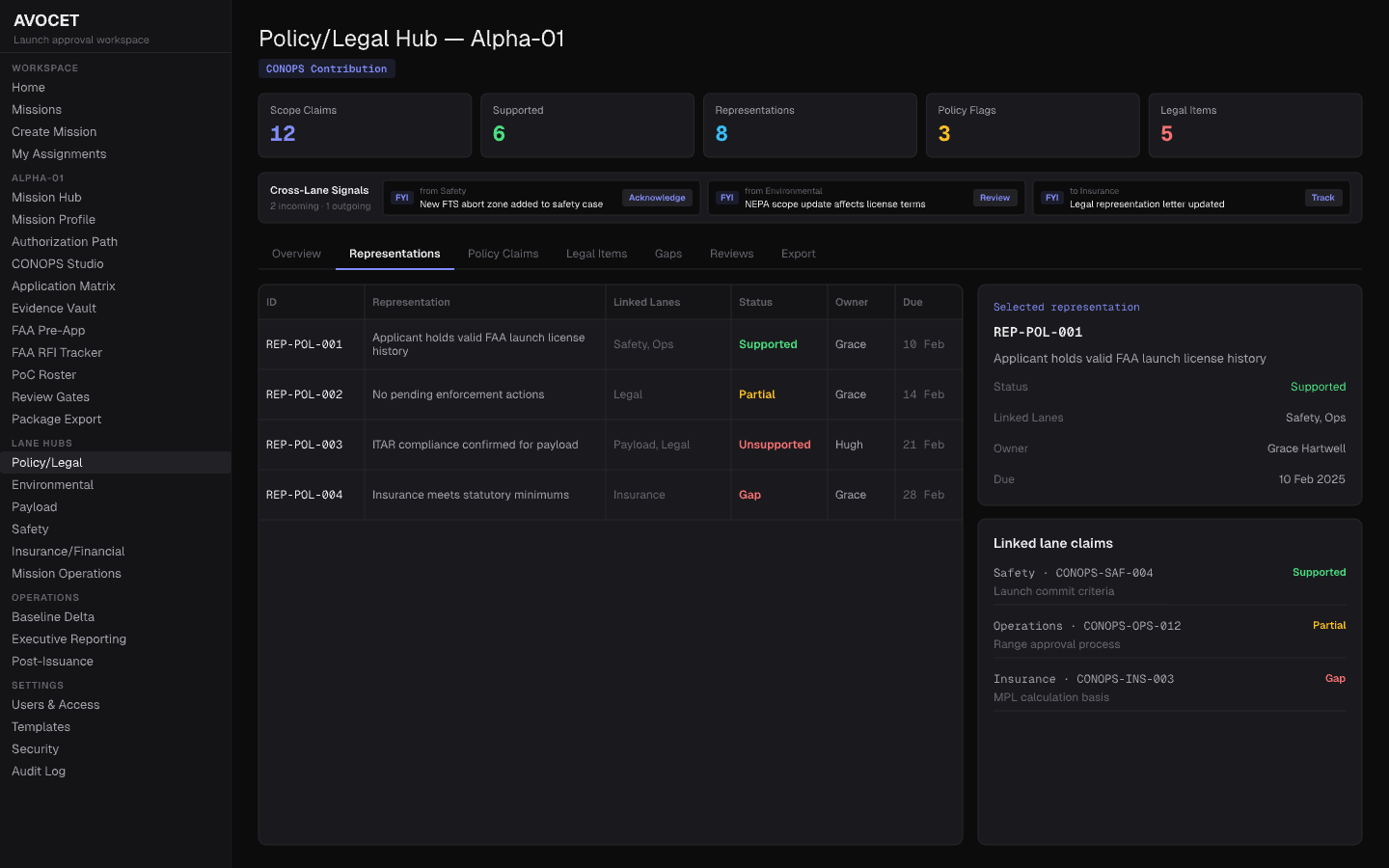
Policy Legal Hub CONOPS Mode
Mission facts, CONOPS structure, policy inputs, and legal context. One workspace instead of a folder hierarchy.
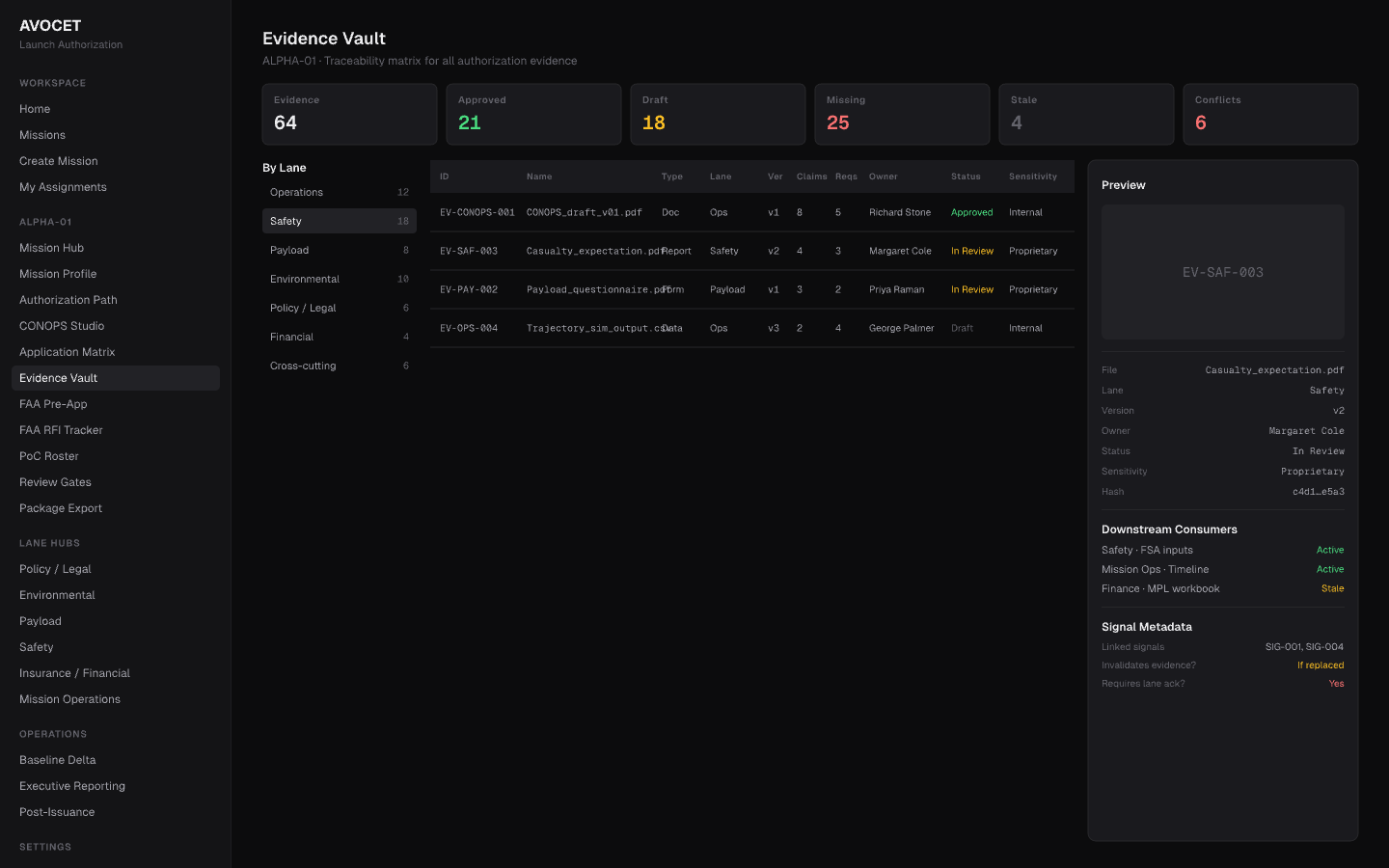
Evidence Vault + Traceability Matrix
Every artifact tied to its requirement, owner, version, and readiness status. You can trace any claim back to its source.
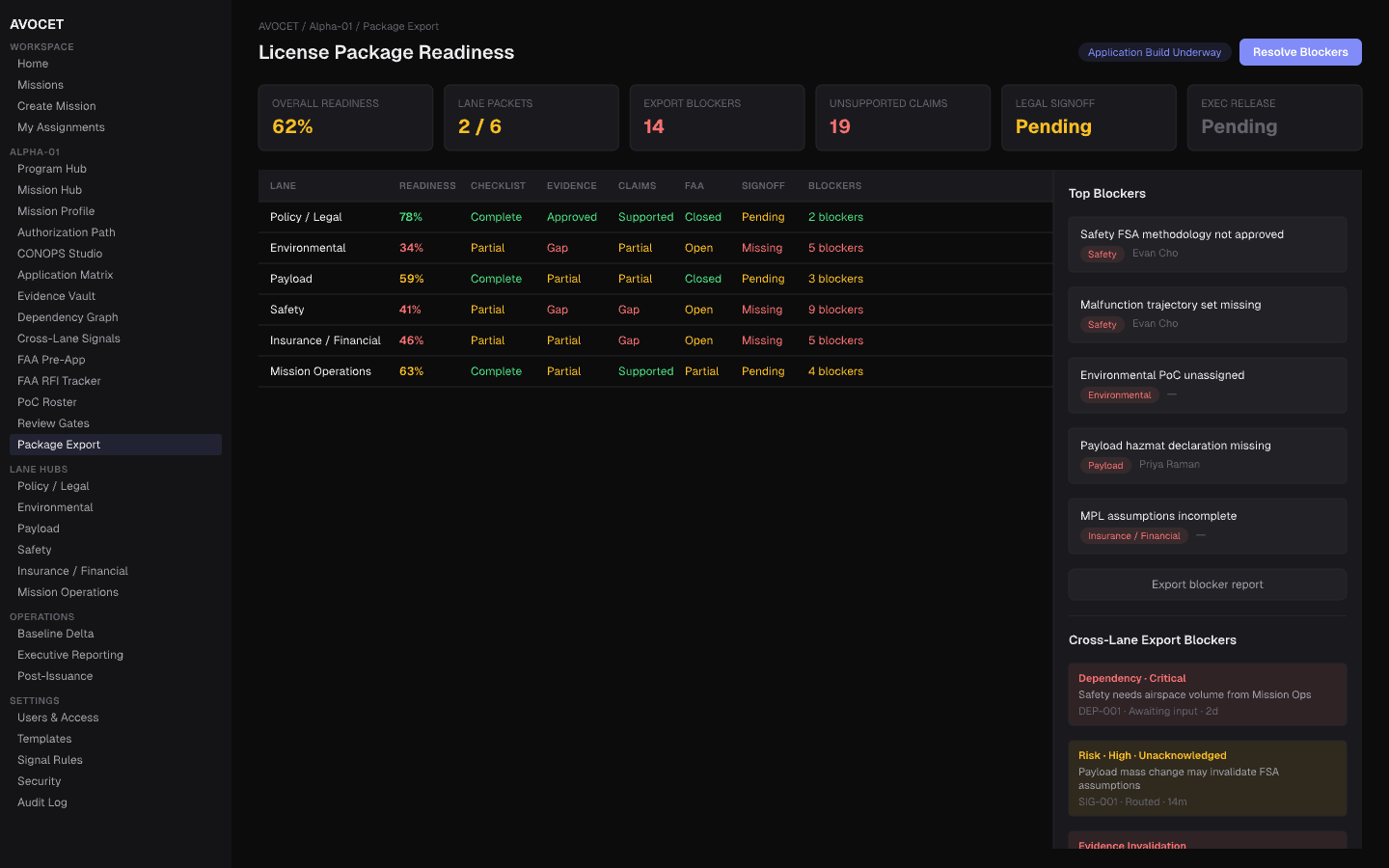
License Package Readiness
See what the package covers, what it is missing, and which review gates are still open.
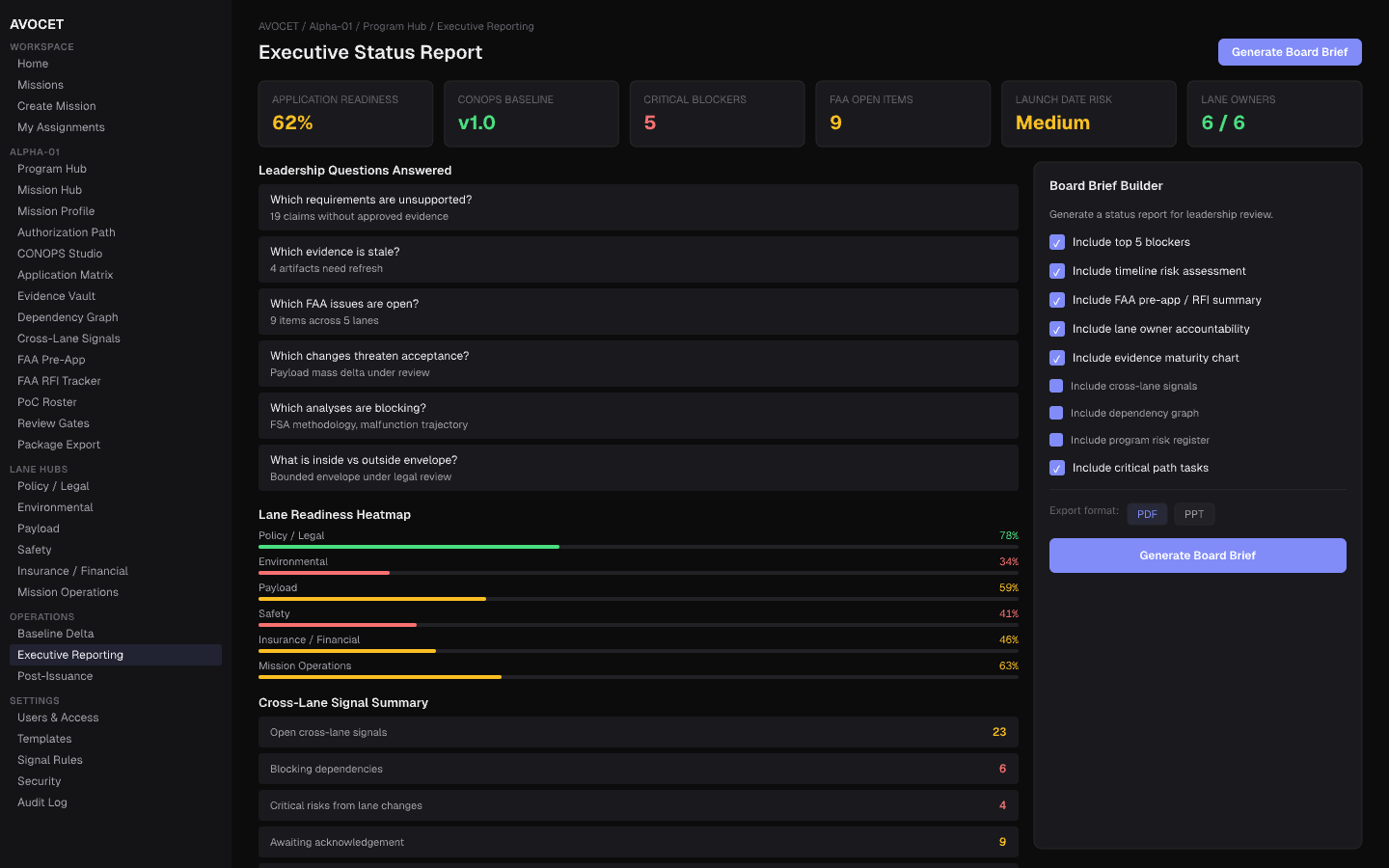
Executive Reporting
Your exec team sees where time is going, which evidence is late, and who is blocking whom. No spreadsheet assembly required.
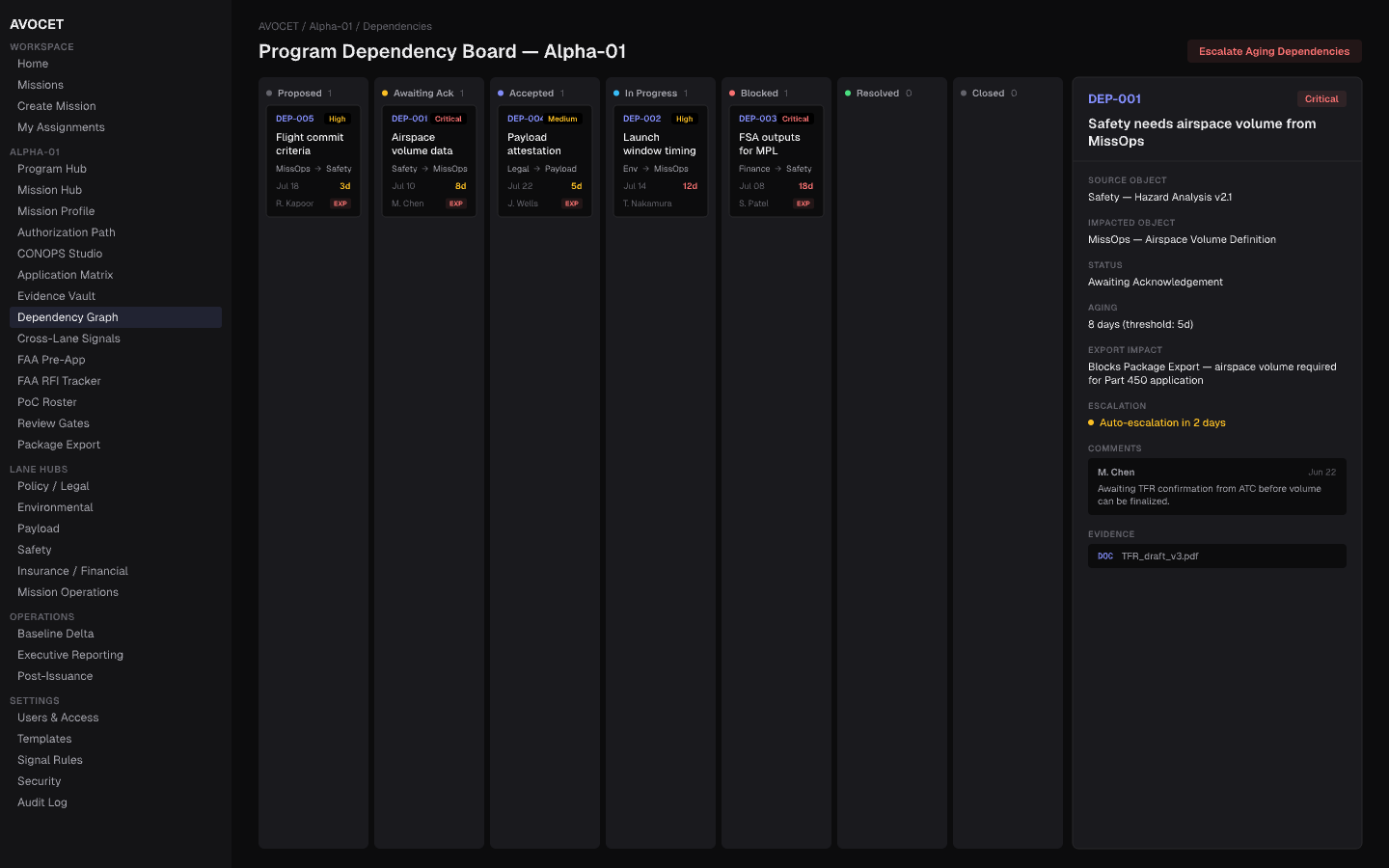
Program Dependency Board
Cross-team dependencies and external blockers, laid out on the licensing timeline. The PM view of what is actually in the way.
New applications become possible with AVOCET.
The evidence vault already has telemetry, timestamps, hashes, trajectory data, anomaly flags, corrective actions, sign-offs, and report drafts. That makes it a mission memory, not just a compliance database.
Normalized telemetry, raw-file manifests, cryptographic hashes, actual-vs-nominal trajectory, FSA envelopes, materiality thresholds, FAA AC mappings, hazard classifications, reviewer notes, and evidence receipts. All queryable. All traceable.
For engineers
T+ Mission Time Machine
Type T+50s. See the telemetry plot, video frame, voice transcript, state vector, and event log for that exact moment. Same clock, same view.
Post-flight archaeology becomes a DVR. No hunting through folders. No timestamp arguments.
Deviation Lens
Shows where the flight left the approved plan: first crossing, max deviation, duration, affected phases, and whether thresholds were exceeded.
"Where did we leave the envelope, by how much, and does it matter?" Answered in one screen.
Anomaly Packet Builder
Pick a flagged event. Get a compact investigation packet: plots, raw values, correlated signals, component history, and evidence trail.
The starter kit an investigation team would otherwise spend hours assembling by hand.
Sensor Trust and Gap Detective
Finds clock drift, missing samples, stale packets, duplicate time ranges, broken uploads, and hash-chain gaps.
Data health check before and after flight. Red, yellow, green confidence badges per sensor.
Fault Tree / Fishbone Assistant
Turns a selected anomaly into a fault tree with candidate contributors, evidence links, dismissed branches, and open questions.
A reasoning artifact that updates as evidence comes in. Not a static slide deck.
For safety, legal & leadership
Materiality Review Room
A review queue where safety, legal, and mission assurance classify events: not material, needs review, material, mishap candidate. Rationale and sign-off trail included.
Reviewers see decisions, not raw telemetry. Every classification links back to evidence.
FAA Report Draft Copilot
Generates the first draft of a 5-day mishap package or 90-day post-flight report. Evidence references and corrective actions are already wired in.
Start from a structured draft instead of a blank document. Review and edit, then submit.
Executive Mission Brief
Plain-English mission summary: what was nominal, what deviated, what is reportable, what is still under review, what needs a decision.
Each sentence can expand into the supporting evidence. Leadership sees risk posture without asking for a briefing.
Evidence Receipt Generator
Tamper-evident receipts for any claim or evidence bundle: data sources, timestamp range, hash proof, reviewers, chain-of-custody.
Legal and regulatory teams can verify claims without learning to read telemetry.
Corrective Action Closure Tracker
Tracks corrective actions from anomaly to closure: verification evidence, next-flight applicability, and sign-off status.
No more spreadsheet chasing. Every open action has proof attached, or it stays open.
Who uses AVOCET.
The people who carry the compliance burden: licensing leads, safety engineers, mission assurance, legal counsel, export-control specialists, program managers, and the executives who get asked "are we ready?" at board meetings.
Licensing Lead
One view of package completeness, evidence gaps, RFI exposure, and submission readiness. No more assembling status from five systems.
Safety Engineer
Trace any safety analysis to its requirement, corrective action, and post-flight evidence. Full lineage, not a folder of PDFs.
Program Manager
See cross-team dependencies, timeline risk, and milestone readiness without spending a day on manual aggregation.
Executive / Board
Licensing readiness, schedule exposure, and cost risk. One dashboard, updated as evidence comes in.
Legaci Labs
We build compliance infrastructure for space operators. AVOCET is our first product: one system for evidence, blockers, review-ready packages, and the human sign-offs that make them real.
Better compliance tooling does not replace human judgment. It gives your team the visibility to move faster without cutting corners.
Ready to see AVOCET?
We are working with early-access operators on pilot deployments. If your team manages licensing, post-flight, or compliance evidence, we should talk.